
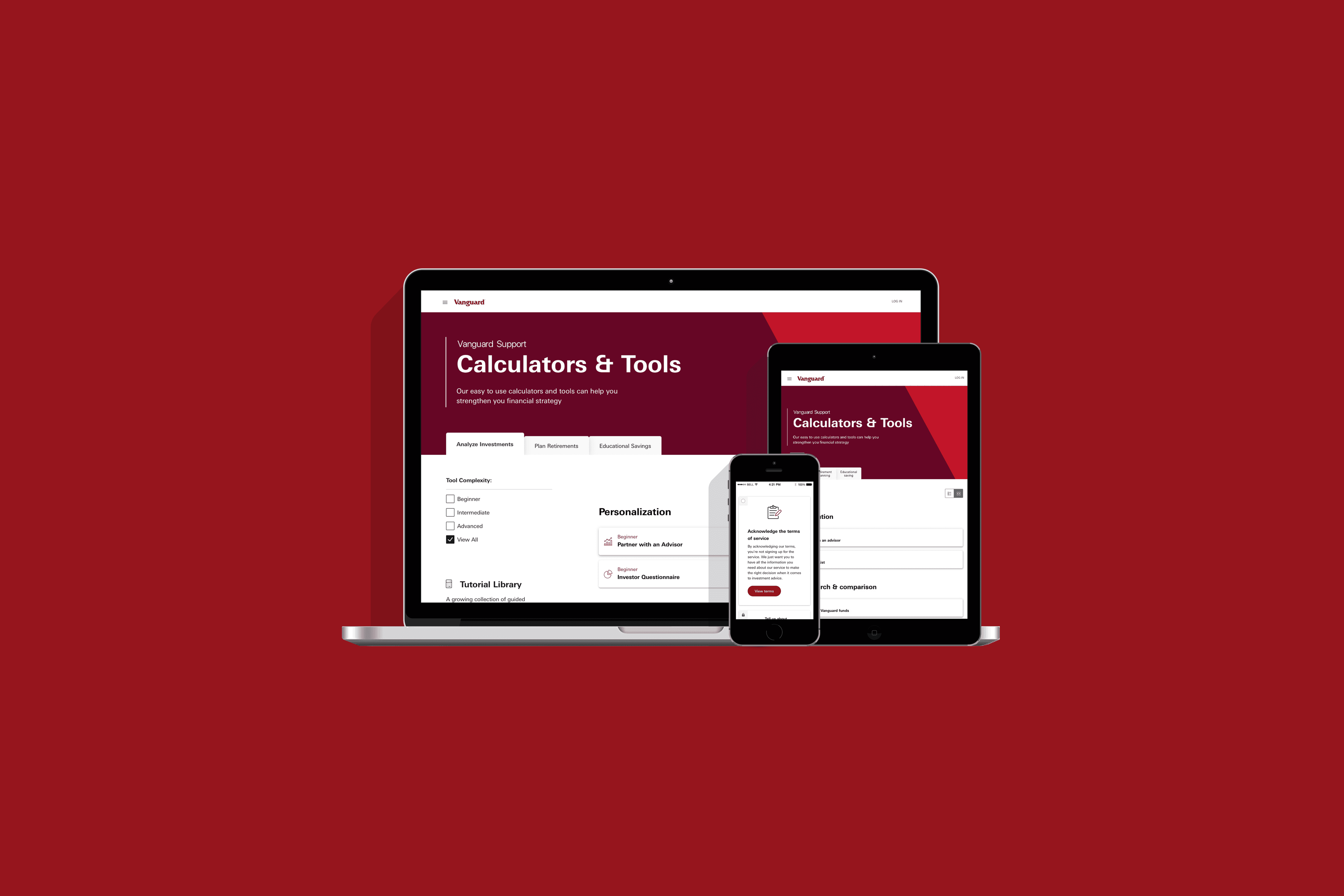
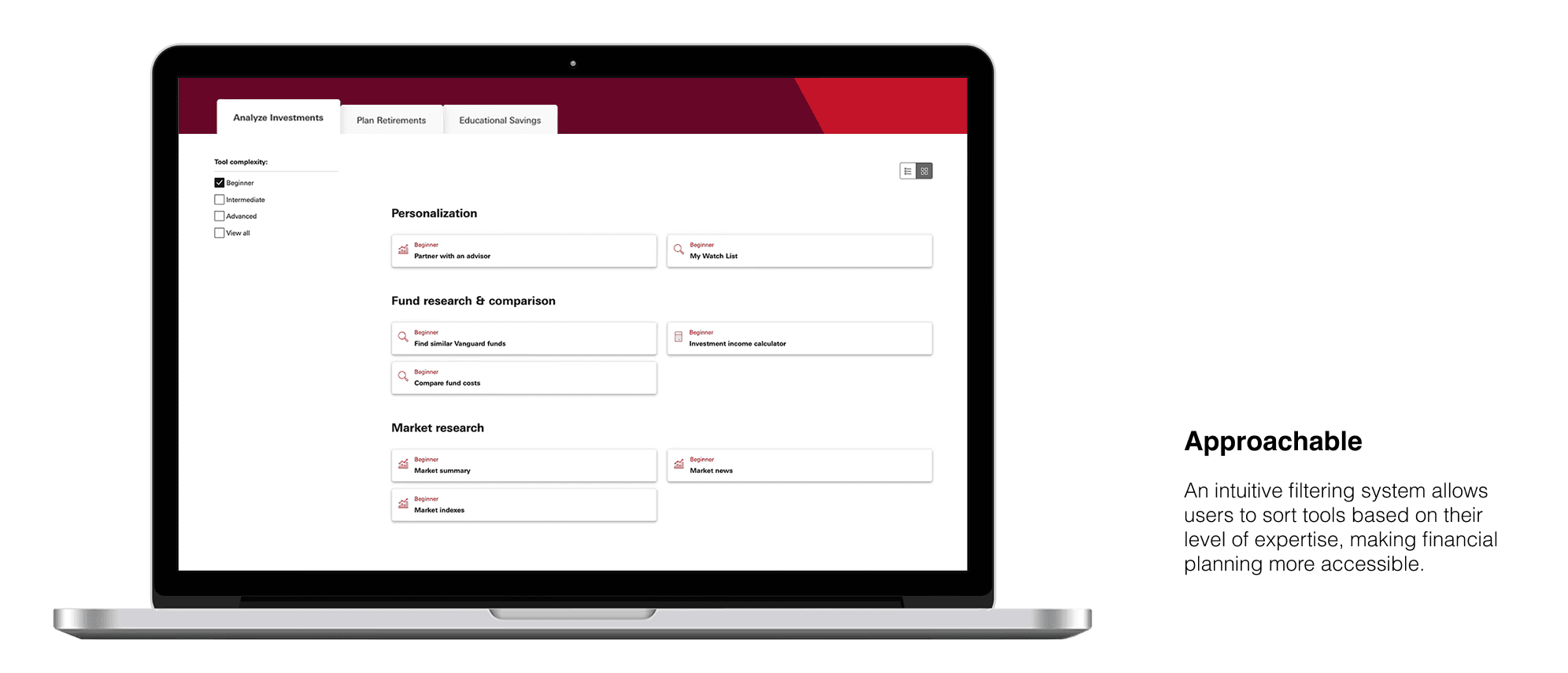
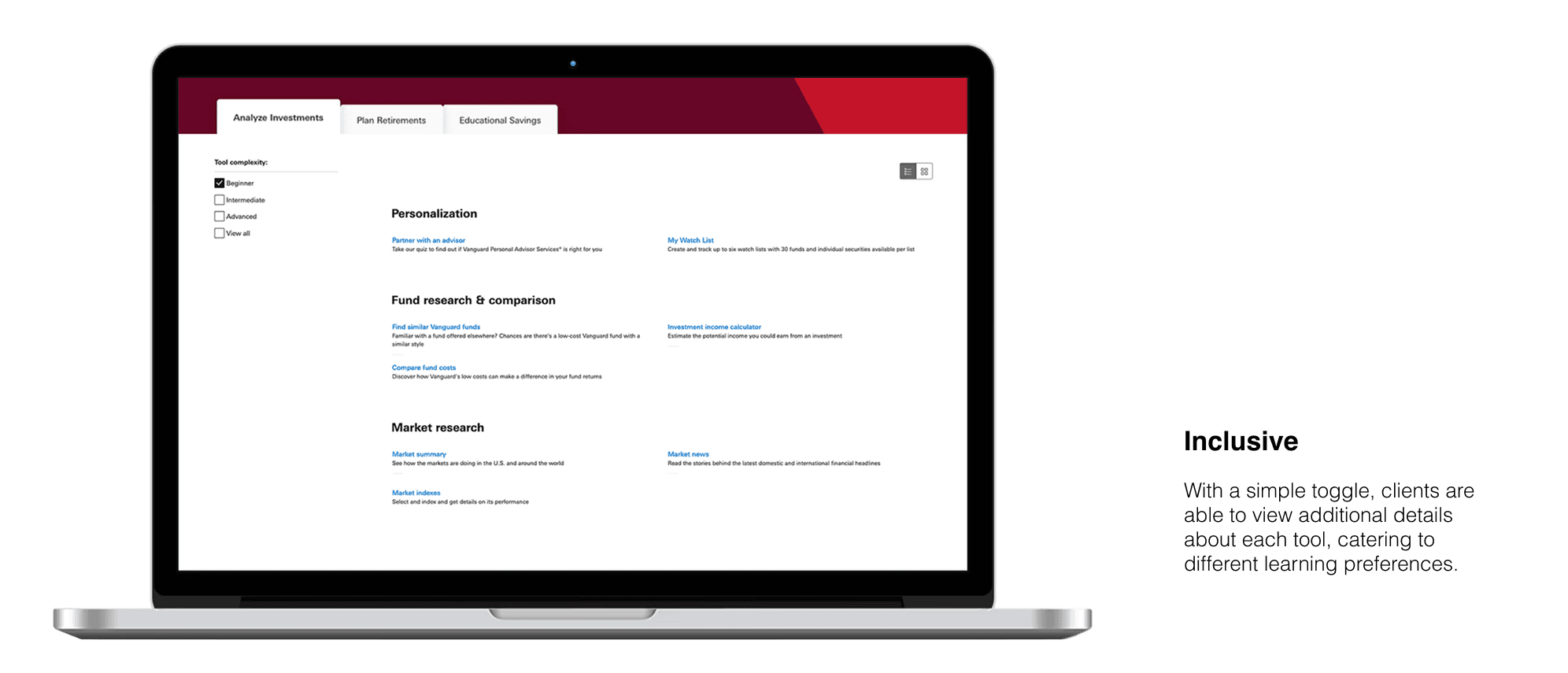
Clients appreciated the breadth of resources available to them and noted that the complexity filter made finance more approachable.
The User Problem
Finance plays a crucial role in people’s lives, yet many struggle with financial literacy, creating barriers to independence and informed decision-making.
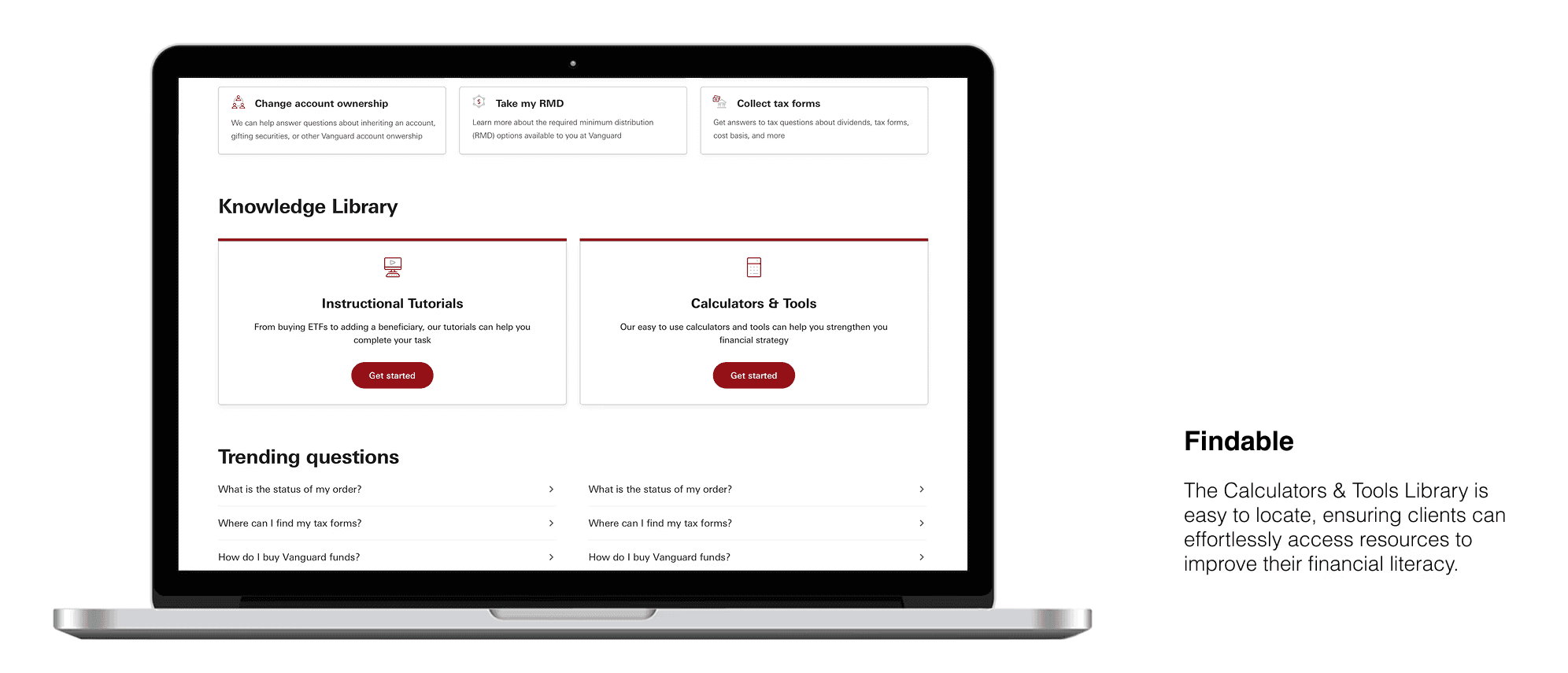
Vanguard offers an extensive suite of financial tools — 2 to 3 times more than competitors — but only about 20% of them are currently being utilized. The core issue? Findability. Most tools are buried behind hyperlinks within text-heavy pages, making them easy to overlook and remain underutilized.
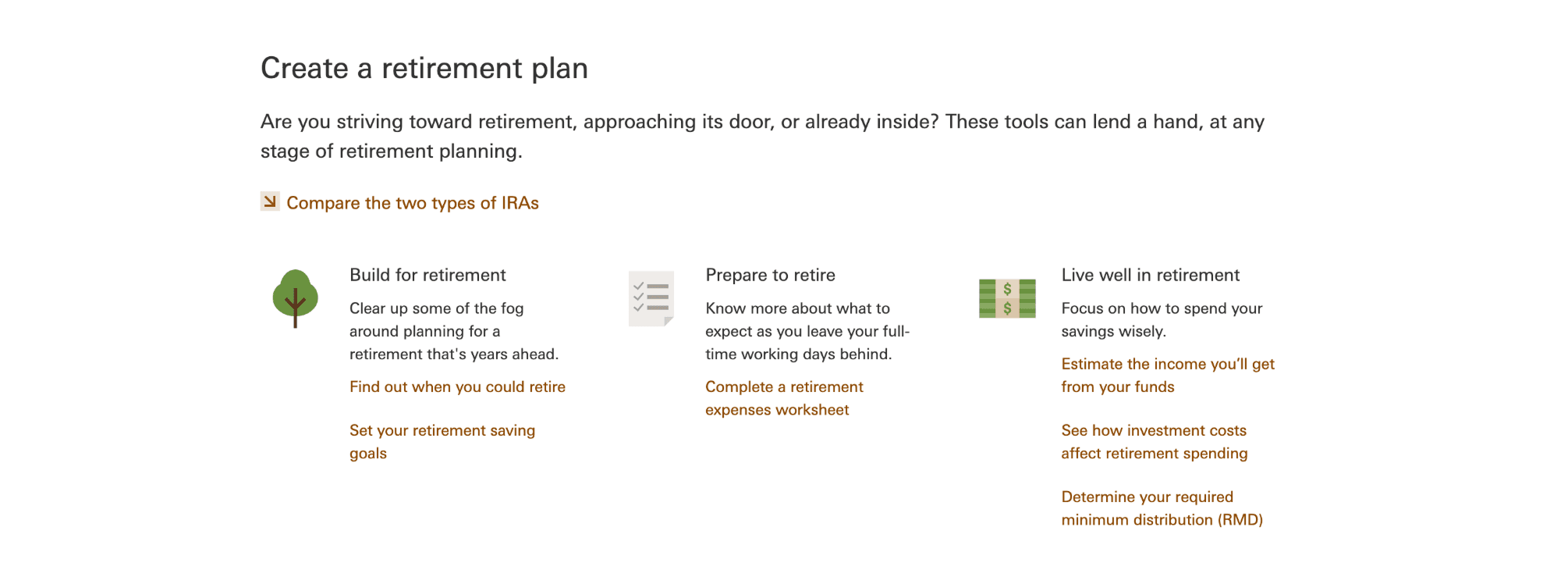
Text-heavy pathways to financial tools make findability an issue.
The Design Journey
Research
To understand the problem, I conducted user interviews with Vanguard clients. I inquired about their awareness of Vanguard’s financial suite of tools, then asked participants to search for tools on the site and interact with a few as I observed.
Key findings
Findability is the primary issue – A small subset of tools are visible, while most are hidden, resulting in low engagement.
Financial literacy impacts usability – Half of the participants struggled to effectively use the tools due to a lack of foundational knowledge.
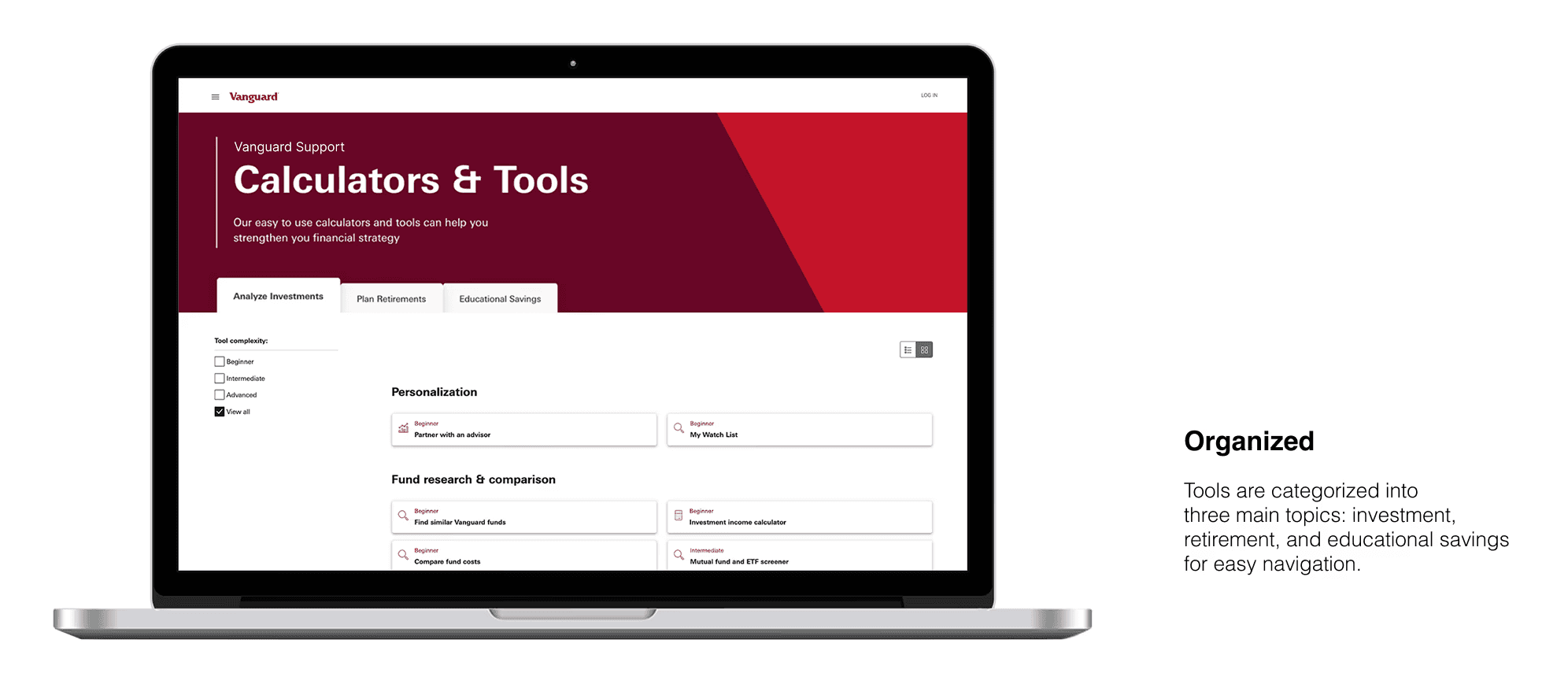
These insights led to the idea of organizing tools into three primary categories: investment, retirement, and educational savings while also allowing users to filter by expertise level to better match their financial journey.
Design & Testing
To refine the expertise level filtering, I conducted both open and closed card-sorting exercises, where participants categorized tools into beginner, intermediate, and expert levels. This approach helped ensure users could find tools suited to their needs without feeling overwhelmed.
Additionally, I drew inspiration from Vanguard’s existing triage system, where clients answer a series of questions to receive tailored support. I adapted this model to help users navigate tools more effectively. To validate our approach, we conducted initial usability testing to ensure we were on the right track.
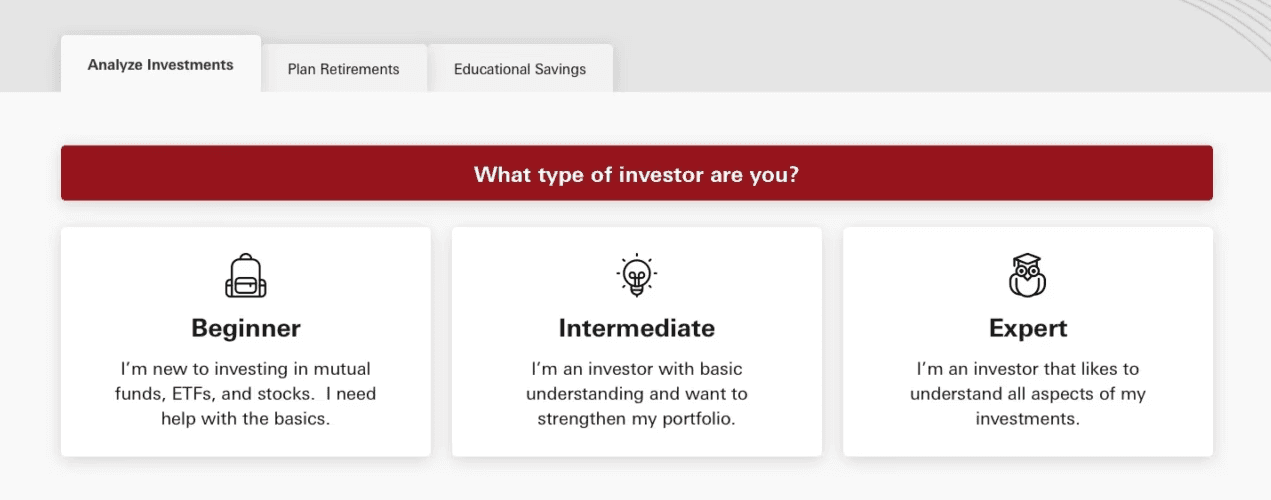
Triage approach to finding tools.
The results revealed 2 key challenges:
Users hesitated when self-assessing expertise. Even experienced investors were reluctant to choose “Expert,” believing there was always more to learn.
Some users felt FOMO (fear of missing out). They wanted visibility into all tools, regardless of their selected level.
Iteration
Recognizing these challenges, I reconsidered whether "expert" was the right label and whether the existing triage pattern from our support page was the best fit. I refined the approach — allowing users to filter by expertise while still providing access to all tools. This would ensure an intuitive yet flexible experience, reinforcing what sets Vanguard apart from competitors.
How might I present tools in a way that is organized, approachable, and inclusive without overwhelming users with too much information at once? Improving visibility and access is key to increasing engagement and tool utilization.
Since the Calculators & Tools Library will be part of a broader Knowledge Library, I embraced a “classic meets modern” visual approach — drawing inspiration from traditional tab and folder structures before digital libraries existed while ensuring a clean, intuitive experience.
The Business Impact
Clients appreciated the breadth of resources available to them and noted that the complexity filter made finance more approachable. They found the page to be intuitive for both younger and older investors, which made the design successful.
RELATED CASE STUDIES
VIEW ALL CASE STUDIES
Grammarly
Extension & App
Helping users understand value fast, resulting in a 40% lift in conversion.
Xfinity
Responsive Web
Designing with people and psychology in mind to increase sales conversions by 11%.